Showing posts with label Capitalism. Show all posts

Tuesday, March 19, 2013

$175,000 Mattress Sold as 'Investment' in Good Sleep

$175,000 Mattress Sold as 'Investment' in Good Sleep
EXCERPTS:

"British mattress manufacturer Savoir Beds this week is launching a limited edition "Royal Bed" with a $175,000 price tag at Kensington Palace in London. Savoir describes its mattress as "an investment" in your well being – presumably since "buying" a $175,000 mattress would just seem ridiculous.

"Ultimately, a "great night's sleep" is what it's all about, said Savoir Beds' managing director Alistair Hughes. "It's an investment that pays off every morning of your life."

"Each mattress will require more than 700 hours of labor. It will contain "masses and masses" of curled Latin American horse tail, "mountains" of pure Mongolian cashmere, and enough specially woven silk to be strung from New York to Miami and almost halfway back again (more than 1,600 miles worth).


"Only 60 of the beds will be made."

"The mattress is fully customizable in size and support – each side of the bed can be made with a different firmness to make both you and your significant other as comfortable as possible.

"Of course it's a massive amount of money and it will only appeal to the very lucky and very wealthy," Hughes acknowledged. But "if you're buying Gucci handbags, a suit from Saville Row or a Rolls Royce, you're looking for the best. And you spend a third of your life in bed."

"And consider this: the bed, mattress and box spring are guaranteed to last at least 25 years (although you'll have to replace the topper every 5-7 years for $5,000-$10,000).
If you divide $175,000 by 365 nights for 25 years, it comes out to less than $20 per night.
Sounds completely reasonable.
© 2013 CNBC.com
URL: http://www.cnbc.com/100563624

Thursday, February 14, 2013

One of a market economy's greatest flaws.... silence

From Donald Boudreaux:

EXCERPTS:

"One of the market economy's greatest flaws is the silence it maintains when it is working relatively flawlessly. When the market stumbles, though — or when it's tripped up by unwise government interventions — a great clamor is heard. Unemployment rises, stock prices and exchange rates plummet, and tales abound of this hardship and that lost dream. Pundits proclaim loudly that the unreliable market must be “corrected” or “tamed” by the wisdom and prudence of politicians. 

But when the market works smoothly — as it typically does — hardly anyone notices. We take its successes for granted. 

That's the thing about a steady stream of relatively small, almost daily improvements in our standard of living. We acclimate to them. 

Recall the first time you saw someone unlock or lock an automobile by using a remote-keyless-entry device. When I first saw someone point a plastic nodule at his car to unlock it from a distance, I marveled. “One day I'll earn enough money to drive a car with that feature!” I told myself. 

***
"That was 1994. I do indeed now drive a car with keyless entry. And so do most Americans. Keyless entry is standard on even low-end automobiles today. Seeing someone unlock or lock a car using a keyless-entry device is as remarkable to us now as seeing a pigeon in Central Park. It's just part of our world.

Yet who invented this device? Do you know? Even if you do know the names of the people whose creativity was key (!) to this invention, those people are likely complete strangers to you. And yet those strangers pondered and experimented and spent time on efforts that resulted in affordable and reliable keyless-entry systems that benefit you . 

Why did they perform these tasks? What mechanisms and institutions bring together all the workers, materials and financing required for the continual production (and improvement) of these handy little devices? 

The answer is “the market.” 

The market is a vast and complex pattern of voluntary choices and exchanges — including the taking of financial risks — that emerge when each individual is free to produce, to sell and to buy according to his or her own individual lights. The only constraints upon such exchanges are the rules of private property and of freedom of contract. If I want your pet frog or your productive factory, I can get it only if I agree to give you something that you voluntarily accept in exchange. 

Unlike in politics, market participants do not confiscate the property of others. Unlike in politics, where those with the most votes get to take unilaterally from those with the fewest votes, in markets, even those with the most money are prevented from unilaterally taking even from those with the least money.

Friday, December 7, 2012

Margaret Thatcher on what's important - Notable & Quotable - WSJ.com

Notable & Quotable - WSJ.com

"My kind of Tory party would make no secret of its belief in individual freedom and individual prosperity, in the maintenance of law and order, in the wide distribution of private property, in rewards for energy, skill and thrift, in diversity of choice, in the preservation of local rights in local communities.

"Size is not all, any more than economic growth is all. Even efficiency is not enough. People come first—their needs, their hopes, their choice, their values and ideals. We have to understand these first—to be seen to be listening with sympathy and concern. It is important to be able to lead, certainly. But you cannot for long lead people where they do not want to go."

Monday, November 12, 2012

The Morality of the Free Market - Walter Williams - YouTube

Prager University: Free Market Morality - YouTube


Walter Williams is another of my favorite economists. He's a UCLA Ph.D. who's been at George Mason University for years.

Friday, October 26, 2012

Atlas Shrugged Part II Trailer - Do you know who John Galt is?

Atlas Shrugged Part II Trailer - YouTube


So far in this course we've seen that government has significant effects on the economy. One of the key issues about which people disagree is the question "what role should government play in the economy, and in regulating how people live and how businesses operate? What are the consequences when government takes an active role in answering the basic three economic questions?"

If you think these are interesting questions to ponder, I recommend to you a movie currently showing in theaters: Atlas Shrugged: Part II. It is part 2 of a trilogy based on the 1957 novel, Atlas Shrugged, by Russian-born novelist Ayn Rand.

In a 1991 survey conducted by the Library of Congress, people were asked which books, of all the books they had read, had been the most influential in their own lives. Atlas Shrugged was listed at number 2. (For me it would probably be number 6.)

People generally react strongly to Rand's work. They tend to love it or hate it. Either way, she definitely makes you think. If you're looking for something to do this weekend, check it out.

Monday, September 3, 2012

"Being poor is what is risky...."

Hysterical MSNBC Host's On Air Meltdown
COMMENT: This video makes a valid point: those who are poor face more risk to their personal safety than do those who are wealthy. So why do we hear so much about business owners bearing risk?

Because the risk business owners bear is risk they bear only if they choose to make investments (start new businesses, build new factories, etc.). They will choose to bear that risk only if they are compensated for doing so.

If government tax policy punishes businesses that are successful this reduces the incentive business have to take risks. And if they choose to not take risks, new businesses aren't started, new factories aren't built, new jobs aren't created, the economy doesn't grow, and the opportunity for those who are poor today to become better off in the future, diminishes.

Tuesday, August 21, 2012

Nike to sell new LeBron James sneakers for $300 | Sports - Home

Nike to sell new LeBron James sneakers for $300 | Sports - Home


resized_nike-lebron-x-sneaker-lebron-james-3[1]
"Nike is selling LeBron James' newest sneaker for over $300. According the Wall Street Journal, LeBron's next shoe, the "LeBron X" will cost around $315. The shoe debuted at the 2012 Olympic gold-medal game between Spain and the United States.

This will be LeBron's 10th shoe release. His first shoe was released in 2003. It was called the Nike Zoom Generation and cost around $110. Nike told the Journal that it is passing along price increases because of the increased cost of materials like cotton.

Tuesday, August 14, 2012

Economic Lessons from the Olympics | Richard W. Rahn | Cato Institute: Commentary

Economic Lessons from the Olympics | Richard W. Rahn | Cato Institute: Commentary

EXCERPTS:

"Civilization can only advance when individuals are both encouraged and rewarded for excellence. The men and women who designed, built, and succeeded in placing the new SUV-sized rover on Mars receive and deserve our acclaim. The late Steve Jobs is widely admired for creating the world's most valuable company and for being a genius in product innovation and marketing. Thomas Edison was even more innovative a century earlier — the light bulb, the phonograph, the electrical generation and distribution system, etc. — and he also built one of the world's largest companies, General Electric.

The good side of humanity is revealed when we praise and reward such people. The bad side of humanity is shown by those who wish to punish success. According to legend, Ivan the Terrible was so impressed by the stellar achievement of the architect he had commissioned to design St. Basil's Cathedral in Moscow that he had him blinded so no other ruler could hire him to produce an equal or greater feat.

The modern day equivalents of Ivan the Terrible are those who pander to the envious and jealous by demanding higher and higher tax rates on the successful. They seek to punish success with the childish demand that they "give back." We pay our successful athletes and musicians a great deal of money because their performances "give" us great pleasure. Sam Walton made tens of billions of dollars because he developed and "gave" us a superior marketing and distribution system that enabled all of us to buy tens of thousands of products at lower prices. Those "evil" real estate developers are the ones who take great risks to build hugely expensive buildings and hire great architects who "give" the rest of us the profile and structures of the cities where we live and work.

We want an economy that produces many well-paying jobs. These are produced by entrepreneurs and businessmen, many of whom have spent considerable time developing their skills, learning from their own mistakes, and often risking their own money. Every job they create is "giving" something to those who are not as equally ambitious, talented, resourceful, hard working or skilled. Why then should the job creators be expected to "give" even more?"

Saturday, August 4, 2012

Milton Friedman, A Centennial Appreciation | Donald J. Boudreaux | Cato Institute: Commentary

Milton Friedman, A Centennial Appreciation | Donald J. Boudreaux | Cato Institute: Commentary

EXCERPTS:

"But at least as important as Friedman's scholarship was his lucid and energetic public advocacy of limited government and free markets. He explained with unmatched clarity how a modern economy's complexities, nuances, and dynamism almost always thwart even the best-intentioned efforts by government officials to intervene into markets.

In a scene from the opening episode of his successful 10-part 1980 PBS series "Free to Choose," Friedman held in his hand an ordinary pencil. Looking into the camera, and speaking without a script, he explained that a pencil — so seemingly simple — requires for its production the knowledge and labors of millions of people from around the world.

Some workers cut down the trees; other workers make the chainsaws used to cut down the trees; yet other workers make the steel used to manufacture the chainsaws; and yet other workers specialize in mining the iron ore used to make the steel. Still other workers mine the graphite to make the "lead" for the pencil, while many others work in factories to make the yellow paint that commonly adorns pencils, while still other workers perform the many tasks required to produce the rubber for each pencil's eraser.

Just to list the number of different, highly specialized jobs that must be performed to produce a commonplace pencil would take volumes. Few of these workers know each other, and none of them knows how to do any more than one or two of the countless jobs that must be done if we are to be well-supplied with pencils.
Friedman explained how free-market prices, along with the lure of profit and the fear of loss, guide entrepreneurs, firms, and workers from across the globe to produce just the right amounts of wood, graphite, paint, erasers, and the many other parts of pencils.

No government commissars are involved. There's no central plan for the production of pencils. Yet we have high-quality pencils in abundance and for sale at low prices. What's true for pencils, of course, is true also for more complex items such as automobiles, electric lighting, MRI machines, and on and on — that is, for nearly every good commonly found in modern industrial society.

Sunday, October 9, 2011

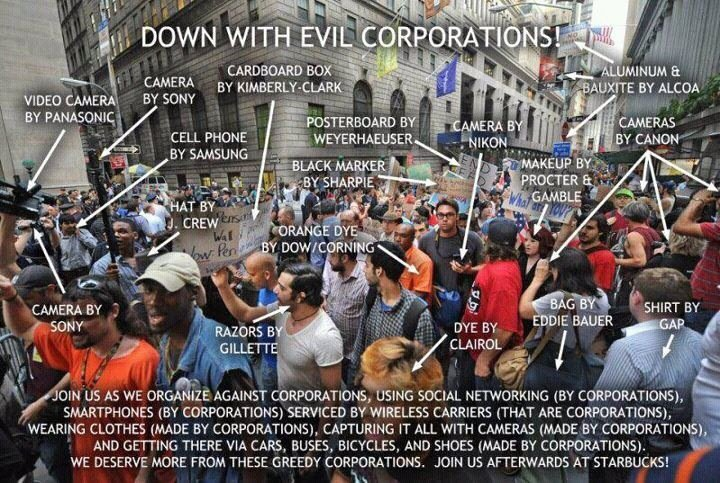
Down with evil corporations !?


Someone posted this comment at Carpe Diem:

"The mostly young crowd packing into NYC to protest against capitalism is all over the news now. There is a certain irony to their declarations against “Big Corporations” henceforth referred to as (BC)

They arrived in their cars, (BC) in airplane(BC)s, and on busses(BC) They alert each other to gatherings over Twitter(BC) and the Internet(BC) using their IPhones(BC) and Ipads (BC)They stay tuned into the latest music(BC) with earphones(BC) plugged into their Ipods. (BC) They wear Nikes, (BC) Reeboks(BC) and Earth shoes(BC), Levis, (BC) Gap (BC)and Old Navy(BC) clothes and smoke cigarettes made by “Big tobacco”. (BC)

They hold signs printed on paper(BC) with markers (BC), beat drums(BC) and use megaphones(BC) to shout out their anti-business slogans. They use the toilets(BC) at McDonalds(BC) and eat food (BC) at any handy eatery(BC). When they use the bathroom they wipe with toilet paper(BC) while sitting on a toilet (BC) and washing their hands in a sink (BC) using soap. (BC)

In short, every single need, want or desire of their lives has been supplied every step of the way by Big Corporations. Were it not for Big corporations they would have had to have heard about the protest from smoke signals from fires lit by flints and burning wood cut with stone axes. They would be dressed in animal skins and would have walked barefooted on dirt paths to get to NYC. They would be doing their business behind trees and wiping with their bare hands. At night they‘d be snuggled up under a homespun blanket made from the fleece of their own sheep.

I’m going to go out on a limb and say that without Big Corporations no one would be there at all. Everyone would be too busy just trying to stay warm and fed.

Wednesday, September 28, 2011

Would you join this protest?

Down With Wall Street, but Keep the Pizza Coming - WSJ.com

"Bre Lembitz, a 21-year-old sleeping in the park and working as a medic, said she is opposed to the way investors' appetites for high profits and ever-greater returns force corporations to cut back on salaries and benefits for workers.

"You have this super-charged profit motive," said Ms. Lembitz, a student at Clark University in Massachusetts who is majoring in international relations and economics. "You don't have the corporate accountability that you need to have."

QUESTIONS:

Does the desire of investors for high profits force companies to cut back on worker salaries and benefits? Should corporations be more accountable?

Friday, September 16, 2011

UPS's Latest Efficiency Move: Ditch the Keys - WSJ.com

UPS's Latest Efficiency Move: Ditch the Keys - WSJ.com

EXCERPTS:

"LOUISVILLE, Ky.—United Parcel Service Inc., already designs its delivery routes to avoid left turns, so as not to waste time waiting for oncoming traffic. And the company requires its drivers to walk at a "brisk pace," which it defines as 2.5 paces a second.

But at an investor conference here, UPS executives said they hit upon another cost-saving strategy: take away the drivers' keys.

They said the company will save $70 million a year by going to a "keyless" system in which drivers will start their vehicle with a fob hooked to their belt.

Currently, UPS drivers are required to carry key rings on their ring finger to avoid wasting time searching for them. During the company's driver-training school, instructors yell out, "raise your hands!" Candidates caught without their keys lose points.

Still, wrangling with keys can eat up valuable seconds, UPS says. Once a driver stops, he or she has to take the keys out of the ignition, and then turn around and use them to unlock the bulkhead door to get to the packages.

Soon, drivers will wear a digital-remote fob on their belts and will be able to turn the engine off with a button that will unlock the bulkhead door at the same time.... That automatic door opening will save 1.75 seconds per stop, or 6.5 minutes per driver per day, while also reducing motion and fatigue, said David Abney, UPS's chief operating officer.

Mr. Abney acknowledged that the company is "obsessive...."

Thursday, August 4, 2011

Saturday, July 30, 2011

New York City's Best Summer Job -Tanning Concierge at James Hotel - WSJ.com

EXCERPTS:

"By 11 a.m. on a recent sweltering Sunday, Harrison Anastasio had already collected the cellphone numbers of five bikini-clad women on the rooftop pool at the James New York Hotel.

"Don't forget to text me," one of the women whispered to the tousle-haired 17-year-old, flashing him a coy smile. Mr. Anastasio colored slightly beneath his Wayfarer sunglasses. But he wouldn't forget. Although it sounds like the setup for a 1980s sex comedy, it's actually his job.

Mr. Anastasio, a rising senior at Edward R. Murrow High School, is one of two attendants at the James's rooftop deck, where he's paid $15 an hour to supervise the four-foot-deep pool, serve water to guests and ready lounge chairs for optimal sun or shade. A certified lifeguard, he's also the pool's tanning concierge—a job the hotel created this summer in partnership with a sunscreen maker.

As concierge, Mr. Anastasio must ensure that pool patrons remember to turn over at designated intervals to evenly brown their front and back sides.

He politely introduces himself to guests when they arrive on the pool deck 18 stories above SoHo. They decide whether they'd prefer the teenager to gently tap them on the shoulder or send a text when it's time to turn over.
"Most people like to be texted. It's less invasive," Mr. Anastasio said. The text comes every 20 to 30 minutes and simply says, "Turn Over."

Tuesday, July 19, 2011

Jobs in Wireless Industry Evaporate - WSJ.com

EXCERPTS:

"The U.S. wireless industry is booming as more consumers and businesses snap up smartphones, tablet computers and billions of wireless applications. But for the industry's workers, the story is less rosy.

In May, on the heels of a record year for industry revenue, employment at U.S. wireless carriers hit a 12-year low of 166,600, according to U.S. Labor Department figures released earlier this month. That's about 20,000 fewer jobs than when the recession ended in June 2009 and 2,000 fewer than a year ago.

The U.S. wireless industry is booming, but for the industry's workers, the story is less rosy.

While the industry's revenue has grown 28% since 2006, when wireless employment peaked at 207,000 workers, its mostly nonunion work force has shrunk about 20%.

The disconnect between employment and industry growth reflects the broader head winds lashing the U.S. job market, as consolidation, outsourcing and productivity gains from new technology and business methods combine to undermine job growth.

***

Those advances do show up, however, in skyrocketing productivity statistics. In 2009, the latest data available, the output per hour of wireless-carrier workers jumped 24.3%, more than in nearly any other service industry, according to a Labor Department report in May. Since 2002, output per hour in the industry has nearly tripled.

***
To be sure, the wireless boom is creating jobs in other industries and occupations, such as software development, publishing and media. Search giant Google Inc. has said it is generating $1 billion a year in mobile-related revenue and will hire more than 6,000 people this year, including many to work on mobile products. Start-ups such as Twitter Inc., Foursquare Labs Inc. and Flipboard Inc., meanwhile, continue to grow at a rapid clip.


Saturday, July 16, 2011

Police in Ga. shut down girls' lemonade stand

EXCERPTS:

"Jul 15, 11:17 AM EDT


MIDWAY, Ga. (AP) -- Police in Georgia have shut down a lemonade stand run by three girls trying to save up for a trip to a water park, saying they didn't have a business license or the required permits.

Midway Police Chief Kelly Morningstar says police also didn't know how the lemonade was made, who made it or what was in it.

The girls had been operating for one day when Morningstar and another officer cruised by.

The girls needed a business license, peddler's permit and food permit to operate, even on residential property. The permits cost $50 a day or $180 per year.

One girl, 14-year-old Casity Dixon, says the three had to listen to police and shut down.

The girls are now doing chores and yard work to make money.

Wednesday, July 13, 2011

Restaurant Bans Young Kids - ABC News

EXCERPTS:

"Starting July 16, McDain's, a Pittsburgh-area restaurant, will ban children under the age of 6 from its dining area. Restaurant owner Mike Vuick said the policy came in response to complaints he'd received from older customers about kids causing a ruckus. In an email to his clientele, Vuick wrote, "We feel that McDain's is a not a place for young children … and many, many times they have disturbed other customers."

"A few weeks ago, Malaysia Airlines announced that it would ban infants from flying in the first-class cabin because other passengers had complained about squalling babies. And last February it was rumored that Virgin Atlantic and British Airways had been pressured to consider child-free zones and even child-free planes to appease business travelers who, according to a travel survey, listed unruly children as their No. 1 travel-related complaint.

"Are these bans even legal? Apparently yes. Federal law forbids discrimination on racial or religious grounds, but there is no blanket protection for children. For business owners like Vuick that means they can set the rules.