Showing posts with label Profit motive. Show all posts
Showing posts with label Profit motive. Show all posts
Tuesday, March 6, 2012
Wednesday, September 28, 2011
Would you join this protest?
Down With Wall Street, but Keep the Pizza Coming - WSJ.com
"Bre Lembitz, a 21-year-old sleeping in the park and working as a medic, said she is opposed to the way investors' appetites for high profits and ever-greater returns force corporations to cut back on salaries and benefits for workers.
"You have this super-charged profit motive," said Ms. Lembitz, a student at Clark University in Massachusetts who is majoring in international relations and economics. "You don't have the corporate accountability that you need to have."
QUESTIONS:
Does the desire of investors for high profits force companies to cut back on worker salaries and benefits? Should corporations be more accountable?
"Bre Lembitz, a 21-year-old sleeping in the park and working as a medic, said she is opposed to the way investors' appetites for high profits and ever-greater returns force corporations to cut back on salaries and benefits for workers.
"You have this super-charged profit motive," said Ms. Lembitz, a student at Clark University in Massachusetts who is majoring in international relations and economics. "You don't have the corporate accountability that you need to have."
QUESTIONS:
Does the desire of investors for high profits force companies to cut back on worker salaries and benefits? Should corporations be more accountable?


Friday, September 16, 2011
UPS's Latest Efficiency Move: Ditch the Keys - WSJ.com
UPS's Latest Efficiency Move: Ditch the Keys - WSJ.com
EXCERPTS:
"LOUISVILLE, Ky.—United Parcel Service Inc., already designs its delivery routes to avoid left turns, so as not to waste time waiting for oncoming traffic. And the company requires its drivers to walk at a "brisk pace," which it defines as 2.5 paces a second.
But at an investor conference here, UPS executives said they hit upon another cost-saving strategy: take away the drivers' keys.
They said the company will save $70 million a year by going to a "keyless" system in which drivers will start their vehicle with a fob hooked to their belt.
Currently, UPS drivers are required to carry key rings on their ring finger to avoid wasting time searching for them. During the company's driver-training school, instructors yell out, "raise your hands!" Candidates caught without their keys lose points.
Still, wrangling with keys can eat up valuable seconds, UPS says. Once a driver stops, he or she has to take the keys out of the ignition, and then turn around and use them to unlock the bulkhead door to get to the packages.
Soon, drivers will wear a digital-remote fob on their belts and will be able to turn the engine off with a button that will unlock the bulkhead door at the same time.... That automatic door opening will save 1.75 seconds per stop, or 6.5 minutes per driver per day, while also reducing motion and fatigue, said David Abney, UPS's chief operating officer.
Mr. Abney acknowledged that the company is "obsessive...."
EXCERPTS:
"LOUISVILLE, Ky.—United Parcel Service Inc., already designs its delivery routes to avoid left turns, so as not to waste time waiting for oncoming traffic. And the company requires its drivers to walk at a "brisk pace," which it defines as 2.5 paces a second.
But at an investor conference here, UPS executives said they hit upon another cost-saving strategy: take away the drivers' keys.
They said the company will save $70 million a year by going to a "keyless" system in which drivers will start their vehicle with a fob hooked to their belt.
Currently, UPS drivers are required to carry key rings on their ring finger to avoid wasting time searching for them. During the company's driver-training school, instructors yell out, "raise your hands!" Candidates caught without their keys lose points.
Still, wrangling with keys can eat up valuable seconds, UPS says. Once a driver stops, he or she has to take the keys out of the ignition, and then turn around and use them to unlock the bulkhead door to get to the packages.
Soon, drivers will wear a digital-remote fob on their belts and will be able to turn the engine off with a button that will unlock the bulkhead door at the same time.... That automatic door opening will save 1.75 seconds per stop, or 6.5 minutes per driver per day, while also reducing motion and fatigue, said David Abney, UPS's chief operating officer.
Mr. Abney acknowledged that the company is "obsessive...."
Wednesday, July 13, 2011
Restaurant Bans Young Kids - ABC News
EXCERPTS:
"Starting July 16, McDain's, a Pittsburgh-area restaurant, will ban children under the age of 6 from its dining area. Restaurant owner Mike Vuick said the policy came in response to complaints he'd received from older customers about kids causing a ruckus. In an email to his clientele, Vuick wrote, "We feel that McDain's is a not a place for young children … and many, many times they have disturbed other customers."
"A few weeks ago, Malaysia Airlines announced that it would ban infants from flying in the first-class cabin because other passengers had complained about squalling babies. And last February it was rumored that Virgin Atlantic and British Airways had been pressured to consider child-free zones and even child-free planes to appease business travelers who, according to a travel survey, listed unruly children as their No. 1 travel-related complaint.
"Are these bans even legal? Apparently yes. Federal law forbids discrimination on racial or religious grounds, but there is no blanket protection for children. For business owners like Vuick that means they can set the rules.
"Starting July 16, McDain's, a Pittsburgh-area restaurant, will ban children under the age of 6 from its dining area. Restaurant owner Mike Vuick said the policy came in response to complaints he'd received from older customers about kids causing a ruckus. In an email to his clientele, Vuick wrote, "We feel that McDain's is a not a place for young children … and many, many times they have disturbed other customers."
"A few weeks ago, Malaysia Airlines announced that it would ban infants from flying in the first-class cabin because other passengers had complained about squalling babies. And last February it was rumored that Virgin Atlantic and British Airways had been pressured to consider child-free zones and even child-free planes to appease business travelers who, according to a travel survey, listed unruly children as their No. 1 travel-related complaint.
"Are these bans even legal? Apparently yes. Federal law forbids discrimination on racial or religious grounds, but there is no blanket protection for children. For business owners like Vuick that means they can set the rules.
Tuesday, May 24, 2011
As Natural Gas Prices Fall, the Search Turns to Oil - WSJ.com
EXCERPTS:
"The natural-gas industry touts its fuel as an attractive alternative to coal and oil, saying it's comparably clean, domestically abundant and cheap.
But that final selling point might not last if the industry succeeds in stirring demand even as it cuts back on drilling.
In the past few years, a glut of natural gas has driven down the price to half the 2008 average—a level where it costs a U.S. consumer $2.75 a day to meet a home's natural-gas needs, according to the American Gas Association. That's good news for consumers, but a recent study by consultancy Wood Mackenzie found that 40% of U.S. natural gas produced last year didn't meet break-even prices for producers.
Natural gas now costs roughly the same as its energy equivalent in coal and a quarter of its energy equivalent in oil. The gas industry is making some headway in capitalizing on its relative cheapness: President Barack Obama has endorsed incentives for trucks powered by natural gas, and power companies are considering replacing coal-fired plants with gas-burning ones.
Those steps would increase natural-gas consumption just as production growth is likely to slow. That's because companies now can make more money drilling for oil, whose price has soared last year and in recent months on unrest in Northern Africa and the Middle East.
Proven U.S. natural gas reserves hold about twice the amount of energy as could be generated by domestic oil reserves, according to a 2009 estimate by the U.S. Energy Information Administration. The nonprofit Potential Gas Committee last month increased its estimate of natural gas available for U.S. production to 2.1 trillion cubic feet. That amount represents a 42% increase in the past four years, and is enough gas to meet domestic needs for 100 years at current consumption rates.
Companies use the same type of rig to drill for oil or gas, and allocate equipment according to which fuel is more profitable to produce. The number of land rigs in the U.S. drilling for natural gas is down 8% from a year ago, while oilrigs are up 81%, according to oilfield-service company Baker Hughes, Inc. In April, companies reported more rigs drilling for oil than gas for the first time since 1995, underscoring how oil's profit margins have fattened.
"All of our drilling ideas compete with each other," Larry Nichols, chairman of Devon Energy Corp., said recently. This year, Devon, a major gas producer, is spending 90% of its nearly $5 billion budget on oil drilling. "You look at the ones where you can make money at current prices, and that's where the money gets allocated," he said.
"The natural-gas industry touts its fuel as an attractive alternative to coal and oil, saying it's comparably clean, domestically abundant and cheap.
But that final selling point might not last if the industry succeeds in stirring demand even as it cuts back on drilling.
In the past few years, a glut of natural gas has driven down the price to half the 2008 average—a level where it costs a U.S. consumer $2.75 a day to meet a home's natural-gas needs, according to the American Gas Association. That's good news for consumers, but a recent study by consultancy Wood Mackenzie found that 40% of U.S. natural gas produced last year didn't meet break-even prices for producers.
Natural gas now costs roughly the same as its energy equivalent in coal and a quarter of its energy equivalent in oil. The gas industry is making some headway in capitalizing on its relative cheapness: President Barack Obama has endorsed incentives for trucks powered by natural gas, and power companies are considering replacing coal-fired plants with gas-burning ones.
Those steps would increase natural-gas consumption just as production growth is likely to slow. That's because companies now can make more money drilling for oil, whose price has soared last year and in recent months on unrest in Northern Africa and the Middle East.
Proven U.S. natural gas reserves hold about twice the amount of energy as could be generated by domestic oil reserves, according to a 2009 estimate by the U.S. Energy Information Administration. The nonprofit Potential Gas Committee last month increased its estimate of natural gas available for U.S. production to 2.1 trillion cubic feet. That amount represents a 42% increase in the past four years, and is enough gas to meet domestic needs for 100 years at current consumption rates.
Companies use the same type of rig to drill for oil or gas, and allocate equipment according to which fuel is more profitable to produce. The number of land rigs in the U.S. drilling for natural gas is down 8% from a year ago, while oilrigs are up 81%, according to oilfield-service company Baker Hughes, Inc. In April, companies reported more rigs drilling for oil than gas for the first time since 1995, underscoring how oil's profit margins have fattened.
"All of our drilling ideas compete with each other," Larry Nichols, chairman of Devon Energy Corp., said recently. This year, Devon, a major gas producer, is spending 90% of its nearly $5 billion budget on oil drilling. "You look at the ones where you can make money at current prices, and that's where the money gets allocated," he said.
Saturday, August 21, 2010
Gates and Buffett Take the Pledge - WSJ.com
EXCERPTS:
"Bill Gates and Warren Buffett announced this month that 40 of America's richest people have agreed to sign a "Giving Pledge" to donate at least half of their wealth to charity. With a collective net worth said to total $230 billion, that promise translates to at least $115 billion.
It's an impressive number. Yet some—including Messrs. Gates and Buffett—say it isn't enough. Perhaps it's actually too much: the wealthy may help humanity more as businessmen and women than as philanthropists.
What are the chances, after all, that the two forces behind the Giving Pledge will contribute anywhere near as much to the betterment of society through their charity as they have through their business pursuits? In building Microsoft, Bill Gates changed the way the world creates and shares knowledge. Warren Buffett's investments have birthed and grown innumerable profitable enterprises, making capital markets work more efficiently and enriching many in the process.
Other signers of the pledge, like Oracle's Larry Ellison and eBay's Pierre Omidyar, have similarly transformed the way people all over the world exchange information and products. They have democratized the transmission of ideas and goods, creating opportunities for people who never would have had them otherwise.
Successful entrepreneurs-turned-philanthropists typically say they feel a responsibility to "give back" to society. But "giving back" implies they have taken something. What, exactly, have they taken? Yes, they have amassed great sums of wealth. But that wealth is the reward they have earned for investing their time and talent in creating products and services that others value. They haven't taken from society, but rather enriched us in ways that were previously unimaginable.
Even if Mr. Gates makes progress in achieving his ambitious philanthropic objectives—eradicating disease, reducing global poverty, and improving educational quality—these accomplishments are unlikely to match what he achieved by giving us the amazing capability we literally have at our fingertips to access and spread information. The very doctors and scientists who may develop cures for diseases like malaria will rely on the tools Microsoft supplies to conduct their research. Had Mr. Gates decided to step down from his company and turn to philanthropy sooner than he did, they might have fewer such tools.
While businesses may do more for the public good than they're given credit for, philanthropies may do less. Think about it for a moment: Can you point to a single charitable accomplishment that has been as transformative as, say, the cell phone or the birth-control pill? To the contrary, the literature on philanthropy is riddled with examples of failure, including examples where philanthropic efforts have actually left intended beneficiaries worse off. The Gates Foundation has itself acknowledged that one of its premier initiatives—a 10-year, $2 billion project to reorganize high schools around the country into schools with fewer than 400 students—was a complete bust. Good for them for admitting it. In that, they are unusual. In the failure, they are not.
I do not mean to belittle philanthropy. I represent a foundation and believe it can accomplish a great deal of good if it achieves its donor's objective, which is to free individuals to pursue their ambitions without the burden of intrusive government. My point is simply that there is nothing inherently better or nobler about using one's resources for charitable purposes than for any number of other ones. If anything, the marketplace does a better job of channeling resources toward where they are most valued, and of punishing failure. Companies shut down all the time. How many philanthropies close because of poor performance?
***
Individuals who plow their parent's money back into the economy—whether by investing it or starting a company—may well feel more rewarded and create more public benefit. Even buying a yacht creates jobs for yacht-builders. Charity may ameliorate problems, but as Carlos Slim, the world's richest man (and a nonsigner of the Giving Pledge), has said: "Poverty is not fought with donations."
Let's hope the philanthropy of those who do sign the Giving Pledge achieves great things. But let's not fool ourselves into thinking that businessmen are likely to achieve more by giving their money away than they have by making it in the first place.
"Bill Gates and Warren Buffett announced this month that 40 of America's richest people have agreed to sign a "Giving Pledge" to donate at least half of their wealth to charity. With a collective net worth said to total $230 billion, that promise translates to at least $115 billion.
It's an impressive number. Yet some—including Messrs. Gates and Buffett—say it isn't enough. Perhaps it's actually too much: the wealthy may help humanity more as businessmen and women than as philanthropists.
What are the chances, after all, that the two forces behind the Giving Pledge will contribute anywhere near as much to the betterment of society through their charity as they have through their business pursuits? In building Microsoft, Bill Gates changed the way the world creates and shares knowledge. Warren Buffett's investments have birthed and grown innumerable profitable enterprises, making capital markets work more efficiently and enriching many in the process.
Other signers of the pledge, like Oracle's Larry Ellison and eBay's Pierre Omidyar, have similarly transformed the way people all over the world exchange information and products. They have democratized the transmission of ideas and goods, creating opportunities for people who never would have had them otherwise.
Successful entrepreneurs-turned-philanthropists typically say they feel a responsibility to "give back" to society. But "giving back" implies they have taken something. What, exactly, have they taken? Yes, they have amassed great sums of wealth. But that wealth is the reward they have earned for investing their time and talent in creating products and services that others value. They haven't taken from society, but rather enriched us in ways that were previously unimaginable.
Even if Mr. Gates makes progress in achieving his ambitious philanthropic objectives—eradicating disease, reducing global poverty, and improving educational quality—these accomplishments are unlikely to match what he achieved by giving us the amazing capability we literally have at our fingertips to access and spread information. The very doctors and scientists who may develop cures for diseases like malaria will rely on the tools Microsoft supplies to conduct their research. Had Mr. Gates decided to step down from his company and turn to philanthropy sooner than he did, they might have fewer such tools.
While businesses may do more for the public good than they're given credit for, philanthropies may do less. Think about it for a moment: Can you point to a single charitable accomplishment that has been as transformative as, say, the cell phone or the birth-control pill? To the contrary, the literature on philanthropy is riddled with examples of failure, including examples where philanthropic efforts have actually left intended beneficiaries worse off. The Gates Foundation has itself acknowledged that one of its premier initiatives—a 10-year, $2 billion project to reorganize high schools around the country into schools with fewer than 400 students—was a complete bust. Good for them for admitting it. In that, they are unusual. In the failure, they are not.
I do not mean to belittle philanthropy. I represent a foundation and believe it can accomplish a great deal of good if it achieves its donor's objective, which is to free individuals to pursue their ambitions without the burden of intrusive government. My point is simply that there is nothing inherently better or nobler about using one's resources for charitable purposes than for any number of other ones. If anything, the marketplace does a better job of channeling resources toward where they are most valued, and of punishing failure. Companies shut down all the time. How many philanthropies close because of poor performance?
***
Individuals who plow their parent's money back into the economy—whether by investing it or starting a company—may well feel more rewarded and create more public benefit. Even buying a yacht creates jobs for yacht-builders. Charity may ameliorate problems, but as Carlos Slim, the world's richest man (and a nonsigner of the Giving Pledge), has said: "Poverty is not fought with donations."
Let's hope the philanthropy of those who do sign the Giving Pledge achieves great things. But let's not fool ourselves into thinking that businessmen are likely to achieve more by giving their money away than they have by making it in the first place.
Wednesday, August 11, 2010
Boom Makers Say BP Left Them Adrift - WSJ.com
EXCERPTS:
"Containment-boom makers and their vendors that ramped up supply for BP PLC after the Gulf of Mexico oil spill say the company suddenly stopped accepting deliveries weeks ago, leaving them with millions of dollars in unused product.
Several makers of the vinyl protective sheaths known as boom and their suppliers say they are deeply in debt and have been forced to lay off workers and delay payment to vendors.
During the height of the oil spill this summer, more than four million feet of containment boom was laid on the water's surface to shield the Gulf Coast. But BP began putting boom orders on hold or rejecting them about the second week in July, as efforts to stop the flow of oil gained ground. On Tuesday, BP said concerns about storms in the Gulf would delay by several days work on a relief well expected to help permanently seal the well.
To be sure, some of the suppliers and manufacturers were speculating on demand, ordering boom and increasing production before they had contracts in place. But The Wall Street Journal interviewed 11 manufacturers and suppliers who said they had contracts with BP or were delivering to those who did. Ten of those manufacturers said they now were out money.
***
About a dozen manufacturers make all the boom used by oil companies, emergency-response companies and marinas in the U.S. The supply on hand dissipated quickly after the Deepwater Horizon oil rig, leased by BP, exploded in April, sending millions of barrels of crude oil into the Gulf. BP suddenly needed boom and lots of it.
But recently the Industrial Fabric Association International, which represents companies including boom makers and their suppliers, says it has received dozens of calls from members who say they are suddenly saddled with containers of inventory, canceled orders and no way to pay their mounting bills.
"Containment-boom makers and their vendors that ramped up supply for BP PLC after the Gulf of Mexico oil spill say the company suddenly stopped accepting deliveries weeks ago, leaving them with millions of dollars in unused product.
Several makers of the vinyl protective sheaths known as boom and their suppliers say they are deeply in debt and have been forced to lay off workers and delay payment to vendors.
During the height of the oil spill this summer, more than four million feet of containment boom was laid on the water's surface to shield the Gulf Coast. But BP began putting boom orders on hold or rejecting them about the second week in July, as efforts to stop the flow of oil gained ground. On Tuesday, BP said concerns about storms in the Gulf would delay by several days work on a relief well expected to help permanently seal the well.
To be sure, some of the suppliers and manufacturers were speculating on demand, ordering boom and increasing production before they had contracts in place. But The Wall Street Journal interviewed 11 manufacturers and suppliers who said they had contracts with BP or were delivering to those who did. Ten of those manufacturers said they now were out money.
***
About a dozen manufacturers make all the boom used by oil companies, emergency-response companies and marinas in the U.S. The supply on hand dissipated quickly after the Deepwater Horizon oil rig, leased by BP, exploded in April, sending millions of barrels of crude oil into the Gulf. BP suddenly needed boom and lots of it.
But recently the Industrial Fabric Association International, which represents companies including boom makers and their suppliers, says it has received dozens of calls from members who say they are suddenly saddled with containers of inventory, canceled orders and no way to pay their mounting bills.
Thursday, June 17, 2010
What Makes E.S. Kluft's Palais Royale Mattress Worth $33,000? - WSJ.com
EXCERPTS:
"How much would you spend for a good night's sleep? Some people might say $33,000. That's the price of E.S. Kluft & Co.'s hand-tufted, king-size Palais Royale mattress and box spring, currently the most expensive American-made mattress set on the market. The company says it has sold about 100 since introducing it in 2008.
At $69,500—roughly the price of a Porsche Cayenne S hybrid SUV—there's the Vividus king-size mattress set from Hästens Sängar AB, of Sweden. Hästens says it takes 160 hours to assemble this mattress entirely by hand, which has a Swedish-pine frame with thick layers of horsehair, cotton, flax and wool inside. The company says since introducing the mattress in 2006, it has sold 250 of them world-wide.
***
... bad sleep was what drove Scott Kimple, a 44-year-old hedge-fund manager in Dallas, to invest $27,500 in a king-size Hästens 2000T mattress set two years ago. "I've had problems sleeping in the last couple of years, and I thought well, maybe a mattress might help," Mr. Kimple says.
"When I heard there was a $20,000 mattress out there, I thought it was kind of ridiculous." But Mr. Kimple is a convert. "It's light years better than anything I've ever slept on. It's like you're floating on air." An added plus: "They will come to your house and flip the mattress for you," Mr. Kimple says. The Hästens store in Dallas offers the monthly service to local customers for the first year; Mr. Kimple had it done.
***
For some, the eye-popping price is part of the appeal. "For any luxury brand, there has to be a perception of scarcity," says Dean Crutchfield, senior partner at Method Inc., a New York brand consulting firm. "If everyone was running around buying these beds, they wouldn't be as special.
"Let's be honest, not everyone can have this. Not everyone can afford this. That's what this is about," Mr. Crutchfield says.
"How much would you spend for a good night's sleep? Some people might say $33,000. That's the price of E.S. Kluft & Co.'s hand-tufted, king-size Palais Royale mattress and box spring, currently the most expensive American-made mattress set on the market. The company says it has sold about 100 since introducing it in 2008.
At $69,500—roughly the price of a Porsche Cayenne S hybrid SUV—there's the Vividus king-size mattress set from Hästens Sängar AB, of Sweden. Hästens says it takes 160 hours to assemble this mattress entirely by hand, which has a Swedish-pine frame with thick layers of horsehair, cotton, flax and wool inside. The company says since introducing the mattress in 2006, it has sold 250 of them world-wide.
***
... bad sleep was what drove Scott Kimple, a 44-year-old hedge-fund manager in Dallas, to invest $27,500 in a king-size Hästens 2000T mattress set two years ago. "I've had problems sleeping in the last couple of years, and I thought well, maybe a mattress might help," Mr. Kimple says.
"When I heard there was a $20,000 mattress out there, I thought it was kind of ridiculous." But Mr. Kimple is a convert. "It's light years better than anything I've ever slept on. It's like you're floating on air." An added plus: "They will come to your house and flip the mattress for you," Mr. Kimple says. The Hästens store in Dallas offers the monthly service to local customers for the first year; Mr. Kimple had it done.
***
For some, the eye-popping price is part of the appeal. "For any luxury brand, there has to be a perception of scarcity," says Dean Crutchfield, senior partner at Method Inc., a New York brand consulting firm. "If everyone was running around buying these beds, they wouldn't be as special.
"Let's be honest, not everyone can have this. Not everyone can afford this. That's what this is about," Mr. Crutchfield says.
Thursday, June 10, 2010
In Louisiana, Scrambling for Work - WSJ.com
EXCERPT:
"VENICE, La.—The Deepwater Horizon oil spill might have spelled doom for Cajun Unlimited, a charter fishing business here in the southeast corner of the state.
The company lost $100,000 worth of booked trips for the summer—high season in this world-class sport-fishing area—as the worst offshore environmental disaster ever to afflict the U.S. scared off the tourists.
But instead of packing up and leaving, owner Jesse Morris, a fourth-generation fisherman born and raised here, dug in. Mr. Morris turned a food kitchen set up for locals and visiting sport fishermen into a small industry that feeds the hordes hired by BP PLC for the cleanup. His staff nearly doubled to about 15 people, who prepare between 1,200 and 1,500 meal boxes a day, for a profit of about $3 each.
Mr. Morris said he has been billing twice as much from the expanded food business as he would from charter fishing....
COMMENT: This is what entrepreneurs do. They recognize opportunities to use resources more effectively. The owner's motivation is to make profit for himself, but the end result is that BP gets the food its workers need. No one told the owner to switch from charter fishing to food supply. He looked at the resources he had, he evaluated the demand for the various products he could produce with them, and made the switch.
QUESTION: If the charter-fishing company had been owned and operated by the government, and Mr. Morris had been the manager employed by the government with a salary that did not depend on the company's revenues from serving customers, and accountable to a supervisor in Washington, do you think the company would have switched from charter service to food supply more quickly, or less quickly?
"VENICE, La.—The Deepwater Horizon oil spill might have spelled doom for Cajun Unlimited, a charter fishing business here in the southeast corner of the state.
The company lost $100,000 worth of booked trips for the summer—high season in this world-class sport-fishing area—as the worst offshore environmental disaster ever to afflict the U.S. scared off the tourists.
But instead of packing up and leaving, owner Jesse Morris, a fourth-generation fisherman born and raised here, dug in. Mr. Morris turned a food kitchen set up for locals and visiting sport fishermen into a small industry that feeds the hordes hired by BP PLC for the cleanup. His staff nearly doubled to about 15 people, who prepare between 1,200 and 1,500 meal boxes a day, for a profit of about $3 each.
Mr. Morris said he has been billing twice as much from the expanded food business as he would from charter fishing....
COMMENT: This is what entrepreneurs do. They recognize opportunities to use resources more effectively. The owner's motivation is to make profit for himself, but the end result is that BP gets the food its workers need. No one told the owner to switch from charter fishing to food supply. He looked at the resources he had, he evaluated the demand for the various products he could produce with them, and made the switch.
QUESTION: If the charter-fishing company had been owned and operated by the government, and Mr. Morris had been the manager employed by the government with a salary that did not depend on the company's revenues from serving customers, and accountable to a supervisor in Washington, do you think the company would have switched from charter service to food supply more quickly, or less quickly?
Wednesday, June 9, 2010
Staying In One of the Country's Most Expensive Hotel Rooms - WSJ.com
EXCERPTS:
"For guests used to staying in the best rooms at luxury hotels, the top suite at the Four Seasons Hotel New York may offer the ultimate in bragging rights: To sleep in it, you have to stomach its $35,000 a night price tag.
The Ty Warner Penthouse, named for the Beanie Baby mogul and the hotel's owner, is the most expensive hotel room in the country outside of Las Vegas, an important distinction in the industry since rooms in the gambling capital are often comped for high rollers. The suite has sweeping views of Manhattan in every direction, bathroom sinks made of solid blocks of rock crystal and a personal butler on-call 24 hours a day. Guests have the use of a Maybach or Rolls-Royce—with driver, of course. Room service from the hotel's restaurants, including one run by celebrity chef Joël Robuchon, is included in the price and nearly unlimited (though one guest was charged for a $1,000 order of caviar).
The suite, which opened in 2007, cost $50 million to build and took seven years to design, the hotel says....
The suite has about 850 light bulbs: Mr. Graziosi keeps about 30 different types on hand for quick replacements. The dark mahogany lacquer bookshelves in the library alone feature about 400 bulbs illuminating a history, art, and biography collection. The $120,000 chandelier over the dinning room table is made of more than 100 tiny fiber optic bulbs.
Only four of the 42-person housekeeping staff are allowed to clean the room. They receive two extra weeks of training, says Margie Garay, director of housekeeping at the hotel, learning how use special chemicals that won't erode the room's delicate surfaces. "We don't use Pledge," she says....
Staff say they try to anticipate penthouse guests' preferences. The hotel keeps files on all return guests detailing their habits and favorite food, drink and even toilet paper. After reviewing one incoming guest's file, staff discovered they needed to track down a particular "tissue," says Ms. Garay. It wasn't easy. Two employees went out separately searching to find the needed "ultraplush" paper product, she says.
Once the penthouse is booked, it's "all hands to the fire," says Anthony Zamora, executive chef at the hotel. The kitchen staff wants to know "do they like tea sandwiches automatically throughout the day or just on request? Should we pre-order caviar from our supplier just in case they request it?" says Mr. Zamora. If a guest is from the Middle East, he may preorder Hildon water, a brand bottled in southern England and popular among guests from the region, he says. Louis Roederer Cristal, the champagne that retails for around $200, is pre-stocked in the room unless the guest prefers something else.
If the guest is coming to the hotel for the first time, intelligence gathering is harder. The three person "special services department" or the general manager's assistant will speak to the guest or his or her assistant about the reason for the visit and the guest's preferences. Employees also scour the Internet for clues and check in with other Four Seasons properties where the guest has stayed. While some guests enjoy the personal service, "others are a little taken aback—'why do you need all these details?'" says Mr. Schmidinger, the general manager.
During a penthouse guest's stay, their personal butler, often Johannes Walz, a soft-spoken 45-year-old from Germany, acts as intermediary between the guest and all hotel staff.
The placement of every object in the room is detailed in a book of more than 50 pages. Then housekeeping staff knows "how many hangers are in the closet, where flowers are placed on tables, how far is a table placed from the piano. How far is the Montblanc blotter from the lamp on the desk," says Ms. Garay. The room is dusted daily and cleaned weekly even when there are no guests in residence.
Changing any aspect of the set up goes through Ms. Aslanian and is ultimately Mr. Warner's decision. It's "like amending the constitution," says Leslie Lefkowitz, director of public relations for the hotel.
"For guests used to staying in the best rooms at luxury hotels, the top suite at the Four Seasons Hotel New York may offer the ultimate in bragging rights: To sleep in it, you have to stomach its $35,000 a night price tag.
The Ty Warner Penthouse, named for the Beanie Baby mogul and the hotel's owner, is the most expensive hotel room in the country outside of Las Vegas, an important distinction in the industry since rooms in the gambling capital are often comped for high rollers. The suite has sweeping views of Manhattan in every direction, bathroom sinks made of solid blocks of rock crystal and a personal butler on-call 24 hours a day. Guests have the use of a Maybach or Rolls-Royce—with driver, of course. Room service from the hotel's restaurants, including one run by celebrity chef Joël Robuchon, is included in the price and nearly unlimited (though one guest was charged for a $1,000 order of caviar).
The suite, which opened in 2007, cost $50 million to build and took seven years to design, the hotel says....
The suite has about 850 light bulbs: Mr. Graziosi keeps about 30 different types on hand for quick replacements. The dark mahogany lacquer bookshelves in the library alone feature about 400 bulbs illuminating a history, art, and biography collection. The $120,000 chandelier over the dinning room table is made of more than 100 tiny fiber optic bulbs.
Only four of the 42-person housekeeping staff are allowed to clean the room. They receive two extra weeks of training, says Margie Garay, director of housekeeping at the hotel, learning how use special chemicals that won't erode the room's delicate surfaces. "We don't use Pledge," she says....
Staff say they try to anticipate penthouse guests' preferences. The hotel keeps files on all return guests detailing their habits and favorite food, drink and even toilet paper. After reviewing one incoming guest's file, staff discovered they needed to track down a particular "tissue," says Ms. Garay. It wasn't easy. Two employees went out separately searching to find the needed "ultraplush" paper product, she says.
Once the penthouse is booked, it's "all hands to the fire," says Anthony Zamora, executive chef at the hotel. The kitchen staff wants to know "do they like tea sandwiches automatically throughout the day or just on request? Should we pre-order caviar from our supplier just in case they request it?" says Mr. Zamora. If a guest is from the Middle East, he may preorder Hildon water, a brand bottled in southern England and popular among guests from the region, he says. Louis Roederer Cristal, the champagne that retails for around $200, is pre-stocked in the room unless the guest prefers something else.
If the guest is coming to the hotel for the first time, intelligence gathering is harder. The three person "special services department" or the general manager's assistant will speak to the guest or his or her assistant about the reason for the visit and the guest's preferences. Employees also scour the Internet for clues and check in with other Four Seasons properties where the guest has stayed. While some guests enjoy the personal service, "others are a little taken aback—'why do you need all these details?'" says Mr. Schmidinger, the general manager.
During a penthouse guest's stay, their personal butler, often Johannes Walz, a soft-spoken 45-year-old from Germany, acts as intermediary between the guest and all hotel staff.
The placement of every object in the room is detailed in a book of more than 50 pages. Then housekeeping staff knows "how many hangers are in the closet, where flowers are placed on tables, how far is a table placed from the piano. How far is the Montblanc blotter from the lamp on the desk," says Ms. Garay. The room is dusted daily and cleaned weekly even when there are no guests in residence.
Changing any aspect of the set up goes through Ms. Aslanian and is ultimately Mr. Warner's decision. It's "like amending the constitution," says Leslie Lefkowitz, director of public relations for the hotel.
Wednesday, May 12, 2010
$45,000 speaking fee attacked - Minneapolis / St. Paul News - The Blotter
EXCERPTS:
"Sandman author Neil Gaiman is under attack by the Minneapolis Star Tribune for charging $45,000 for a recent speaking engagement at a Stillwater public library. The story was originally broken by Politics in Minnesota, which quoted one angry librarian wagging his or her tongue, but only after demanding anonymity. "I am a librarian and on the library side, supposedly, but this makes my blood boil," the librarian said. "This is ridiculous. There are people who need food and who have lost their homes, and this is just plain disgusting."
"Sandman author Neil Gaiman is under attack by the Minneapolis Star Tribune for charging $45,000 for a recent speaking engagement at a Stillwater public library. The story was originally broken by Politics in Minnesota, which quoted one angry librarian wagging his or her tongue, but only after demanding anonymity. "I am a librarian and on the library side, supposedly, but this makes my blood boil," the librarian said. "This is ridiculous. There are people who need food and who have lost their homes, and this is just plain disgusting."
Saturday, April 24, 2010
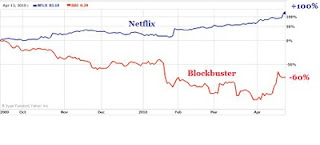
Netflix +100% vs. Blockbuster -60% - from CARPE DIEM
Want to understand how a market economy works? Consider Blockbuster Video, Netflix, Redbox, and streaming.
EXCERPTS:
"First, people decided they didn't want to drive to the movie theater. These days they aren't too keen on driving to the video store, either. In a sign of the times, Netflix saw its stock price top $100 a share Thursday after posting blowout earnings – the same week that another Blockbuster outlet closed, this one on 29th and K streets in Sacramento. Blockbuster and Hollywood Video are closing local outlets as nationally, both companies feel the heat from game changers like Netflix and Redbox, which rents movies for $1 a night out of vending machines in supermarkets.
"Brick and mortar video stores are under pressure from the online world, just like record stores and booksellers before them. We want to rent DVDs quickly by mail or pick them up at the supermarket. And that's if we bother handling a physical disc at all. Increasingly, we just stream movies on laptops and smart phones or download them right to our PlayStations or Xboxes, so we can watch them on our flat-panel TVs.

EXCERPTS:
"First, people decided they didn't want to drive to the movie theater. These days they aren't too keen on driving to the video store, either. In a sign of the times, Netflix saw its stock price top $100 a share Thursday after posting blowout earnings – the same week that another Blockbuster outlet closed, this one on 29th and K streets in Sacramento. Blockbuster and Hollywood Video are closing local outlets as nationally, both companies feel the heat from game changers like Netflix and Redbox, which rents movies for $1 a night out of vending machines in supermarkets.
"Brick and mortar video stores are under pressure from the online world, just like record stores and booksellers before them. We want to rent DVDs quickly by mail or pick them up at the supermarket. And that's if we bother handling a physical disc at all. Increasingly, we just stream movies on laptops and smart phones or download them right to our PlayStations or Xboxes, so we can watch them on our flat-panel TVs.
Thursday, January 28, 2010
Who’s Greedy? -- from Cafe Hayek
EXCERPT:
"Curiously, the set of self-interested actions that are widely praised are those whose positive effects redound almost exclusively to each self-interested actor. If I exercise and eat right, the resulting health and beauty benefits are mine alone. My healthier heart, bulgier biceps, and more-slender body do nothing to improve my neighbor’s well-being. (In fact, my exercise and good diet might harm him, for they improve my chances of getting the pretty girl whom we’ve both been eyeing.)
In contrast, prominent among the self-interested actions that are popularly suspect are those whose fulfillment requires self-interested actors to provide benefits to others. Of course, the business firm that earns profits in the market yields benefits to its self-interested principals – but it does so only insofar as it yields benefits to others. And the greater the benefits provided to others, and the greater the number of others provided with these benefits, the greater are the benefits that the self-interested, profit-seeking business principals enjoy. That is, when someone selfishly jogs to improve his or her health, we applaud. When that same someone selfishly seeks financial profit by offering goods or services for sale to consumers, many of us are wary. (And even most of the other of us who aren’t wary don’t positively praise this variety of self-interested behavior. We merely tolerate it as necessary.)
Selfish behavior that is exclusively self-regarding is praised; selfish behavior that requires the selfish actor to consider and satisfy and please strangers is suspect."
"Curiously, the set of self-interested actions that are widely praised are those whose positive effects redound almost exclusively to each self-interested actor. If I exercise and eat right, the resulting health and beauty benefits are mine alone. My healthier heart, bulgier biceps, and more-slender body do nothing to improve my neighbor’s well-being. (In fact, my exercise and good diet might harm him, for they improve my chances of getting the pretty girl whom we’ve both been eyeing.)
In contrast, prominent among the self-interested actions that are popularly suspect are those whose fulfillment requires self-interested actors to provide benefits to others. Of course, the business firm that earns profits in the market yields benefits to its self-interested principals – but it does so only insofar as it yields benefits to others. And the greater the benefits provided to others, and the greater the number of others provided with these benefits, the greater are the benefits that the self-interested, profit-seeking business principals enjoy. That is, when someone selfishly jogs to improve his or her health, we applaud. When that same someone selfishly seeks financial profit by offering goods or services for sale to consumers, many of us are wary. (And even most of the other of us who aren’t wary don’t positively praise this variety of self-interested behavior. We merely tolerate it as necessary.)
Selfish behavior that is exclusively self-regarding is praised; selfish behavior that requires the selfish actor to consider and satisfy and please strangers is suspect."
Saturday, January 2, 2010
The anti-capitalist mentality - WSJ.com
"The anti-business mindset . . . is worthy of a pampered adolescent who is searching for a cause with which to display his unique moral sensibility. It is not worthy of an adult who should be able to use his imagination, if not actual experience, to appreciate the extraordinary human effort that has gone into creating the delightful tools that we daily take for granted. On my desk sit various humble objects—a tiny clock, a stapler, a paper clip box, a Lucite cook book stand for holding up drafts and other papers while I type. Each object represents a fractal geometry of complexity, composed as it is of parts that themselves require enterprise to manufacture, assemble, and deliver, all born along on waves of energy and infrastructure to which yet another set of entrepreneurs contributed. The fact that all of those distributors and manufacturers tried to make a profit does not detract from the fact that they offered goods which enhance our lives. . . .
It is the ingratitude that kills me the most among anti-business types. The materials that furnish a single room in an American home required daring, perseverance, and organizational skill from millions of individuals over generations. I hope they all got filthy rich."
It is the ingratitude that kills me the most among anti-business types. The materials that furnish a single room in an American home required daring, perseverance, and organizational skill from millions of individuals over generations. I hope they all got filthy rich."
Subscribe to:
Posts (Atom)